
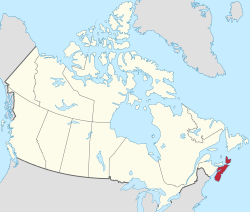
 |
Population: 1,079,627 Number of K-12 Schools: 370 Number of K-12 Students: 133,531 . Number of K-12 Distance Learning Programs: 2 Number of K-12 Distance Learning Students: 3,753 |
Note that these profiles are taken from the most recent edition of the report, please review additional annual profiles below.
Governance and Regulation
The provision of distributed learning (i.e., distance education and online learning) is governed by provisions included in the agreement between the Government of Nova Scotia and the Nova Scotia Teachers Union. This collective agreement defines distributed learning as:
a method of instruction that relies primarily on communication between students and teachers through the internet or other electronic-based delivery, teleconferencing, video conferencing or e-correspondence. It allows teachers, students, and content to be located in different, non-centralized locations so that instruction and learning can occur independent of time and place. (Government of Nova Scotia, 2024, p. 56)
In addition to defining distributed learning, there are several clauses related to distributed learning teacher working conditions (e.g., requirement that the teacher be certified; requirement that distributed learning be considered part of the teacher’s formal workload; maximum distributed learning class size; mandated professional development for distributed learning teachers; and distributed learning school day can be different, but must be equivalent).
Further, the collective agreement outlines a number of responsibilities for the schools and/or regional centres for education/school boards that choose to operate distributed learning programs:
- schools must have student supervision at the local level when students are engaged in distributed learning;
- schools must have a local distributed learning coordinator; and
- if the course exists in the student’s local school, they must receive approval from the regional Program Director or designate to take the course in a distributed learning environment.
Finally, there is a clause that creates a formal mechanism to allow for consultations between distributed learning program operators and the union through a provincial advisory committee.
K-12 Distance and Online Learning Activity
The Department of Education and Early Childhood Development manages two active Distributed Learning programs available to NS public school students, the Nova Scotia Virtual School (NSVS) program and the Nova Scotia Independent Online Learning (NSIOL) program. Students at all public high schools, including Adult High Schools managed by the Department of Labour, Skills & Immigration, have access to courses through NS Distributed Learning.
The NSVS, including its French first language counterpart, provided online courses to approximately 2,653 students during the 2024-25 school year. These courses are taken in-person under the supervision of a teacher at school, while students work independently on coursework in the learning management system and regularly meet with their virtual teacher online. NSVS allows province-wide equitable access to specialized courses and helps to resolve scheduling challenges for students regularly attending public school. Registration is submitted to a regional NSVS registrar by the student’s school contact, generally a school counsellor or registrar and then to the Department of Education and Early Childhood Development.
The NSOIL program, which began in 2023, served 1,100 students in 11 different courses during the 2024-25 school year. This program is designed for students who need a flexible schedule where they can work toward high school credits independently. Courses are hosted in the learning management system and designed for independent learning with virtual support from a course mentor. Course mentors are licensed teachers in the subject area who do not teach the course, but provide oral and written feedback on student formative and summative assessments and meet with students at designated points in each unit of study to offer course-specific, personalized advice on each student’s progress and next steps. Registration is submitted to the Department of Education and Early Childhood Development directly by the student’s school contact, generally a school counsellor or registrar. A new registration and communication system, implemented for NSIOL in 2024-25, has streamlined the registration process and provided direct access to student status and course progress information for school contacts, families, and other care givers through the school system and provincial government single-sign-on process.
As of March 2025, a distributed learning navigator was hired full time to support students, school staff, and families navigating distributed learning options and available supports. The navigator monitors student progress and regularly liaises with school contacts, NSIOL mentors, and NSVS lead teachers to help ensure that students have the supports that they need to succeed in distributed learning courses, and that all involved adults have the information they need to effectively support these students.
K-12 Blended Learning Activity
All teacher, administrators and students from primary up to returning graduates have access to blended learning tools through Google Workspace for Education and a variety of other platforms. Most teachers continue to use Google Classroom to organize and share course their own class resources. The learning management is also available to teachers as a blended learning platform and is used to share resources with all teachers and students at most grade levels. The required Citizenship 9 course includes a blended component through Moodle.
Every school has access to a variety of blended learning options, and their use may vary throughout the school year. As such, it is difficult to draw conclusions from usage data, which is not explicitly tracked over time.
References
Government of Nova Scotia. (2024). Agreement between the Minister of Education and Early Childhood Development of the Province of Nova Scotia and the Nova Scotia Teachers Union. https://nstu.blob.core.windows.net/nstuwebsite/data/agreements/TPA%202023-2026%20-%20Final.pdf
Previous Provincial Profiles
History of K-12 E-Learning
Beginning about 1917, when soldiers were returning from World War 1, the distance education program started by offering correspondence education opportunities to obtain high school graduation certificates. Through the years, Nova Scotia has had rich distance education programming to take advantage of various technologies as they became available (radio, television, internet, email, telephone, video conferencing).
An educational television program (ETV) began in 1960, but is no longer in operation. It was funded by the Department of Education and began as a way of providing instruction from competent teachers in high school mathematics, science, and French as a second language to students in rural schools. It consisted of a partnership with the Canadian Broadcasting Company to develop and then broadcast the high school curriculum. By the late 1970’s, ETV was changing from direct teaching of individual classes to the creation of broader educational resources that were not otherwise available. The most notable was the Mi’kmaq series that recreated four seasons in pre-European contact Maritimes.
The Nova Scotia Virtual School (NSVS) was created from this long history of distance education, as well as a more recent history of individual, district-level, web-based initiatives that had been operating throughout the province (i.e., Strait Regional School Board Virtual School and Chignecto-Central Virtual School). In 2011-12, funding for NSVS was increased to allow course offerings to be brought together under one provincial umbrella, to increase course development, to enhance course quality and infrastructure, and to provide sustainable online learning to all public high school students. Planning for growth and innovation for NSVS is accomplished through a Management Board with representation from every school board in the province and the Department of Education and Early Childhood Development. This cooperative structure works together to advance online learning opportunities for Nova Scotia students.
Vignettes
- Nova Scotia Virtual School Model For Support Students (2019)
- Blended Learning In Chemistry 11 (2019)
- Citizenship 9 (2018)
- Steven Van Zoost, Nova Scotia Virtual School (2016)
- Pugwash District High School (2013)
- Guy Aucoin, Nova Scotia Virtual School (2012)
- Tommy Chisholm, Online Teacher (2011)
- Chignecto Central Virtual School (2009)
Individual Program Survey Responses
| Program | Most recent response | Medium | # of Students | # of Teachers | # of Courses |
| Nova Scotia Virtual School http://nsvs.ednet.ns.ca |
2018-19 | Online | 1366 | 25 full time | 53 |
| Nova Scotia Correspondence Study Program http://csp.ednet.ns.ca |
2018-19 | Correspondence and Online (mathematics only) | 1,015 | 20 part time* | 27 |
* The Nova Scotia Correspondence Study Program utilizes markers on an as needed basis.
To update this information, visit http://tinyurl.com/sotn-program-survey
Inter-provincial and International
Any online course from an online program outside of the province taken by a student in Nova Scotia would be reviewed at the school or board level to determine if an equivalent course exists.
Unless a student is registered in a public school in Nova Scotia students are not eligible to take an online course through the NSVS. If an adult student within the province or a student from outside of Nova Scotia were interested in taking a distance education course from a program located in Nova Scotia, the student would be directed to the province’s correspondence study program. For out-of-province students who successfully complete courses through this program, the Ministry issues a completion certificate and sends a transcript to schools as requested.